
Key takeaways
- Most business websites score below 40 out of 100 on AI readiness. Not because they're bad websites. Because nobody built them for the second audience now visiting: AI agents.
- The AI Readiness Scanner is a free tool that checks your site across 8 critical dimensions in seconds. No signup. No credit card. Just your domain.
- The fixes are usually simple. A structured profile, cleaner markup, consistent facts. Most businesses go from AI-invisible to AI-readable in under an hour.
You have a website. It looks great. It ranks. Customers find you.
But there's a second audience visiting your site now. One that doesn't see your design, doesn't read your copy the way a human does, and doesn't care about your brand story. This audience is AI agents: ChatGPT, Claude, Gemini, Perplexity, and the growing ecosystem of autonomous agents that crawl the web to answer questions and make recommendations.
When an AI agent visits your site, it's not browsing. It's extracting. It checks for structured signals (does this site have an llms.txt file? Schema markup? A sitemap?) and evaluates whether it can assemble a complete, accurate picture of your business. If it can't, it guesses. Or it skips you entirely.
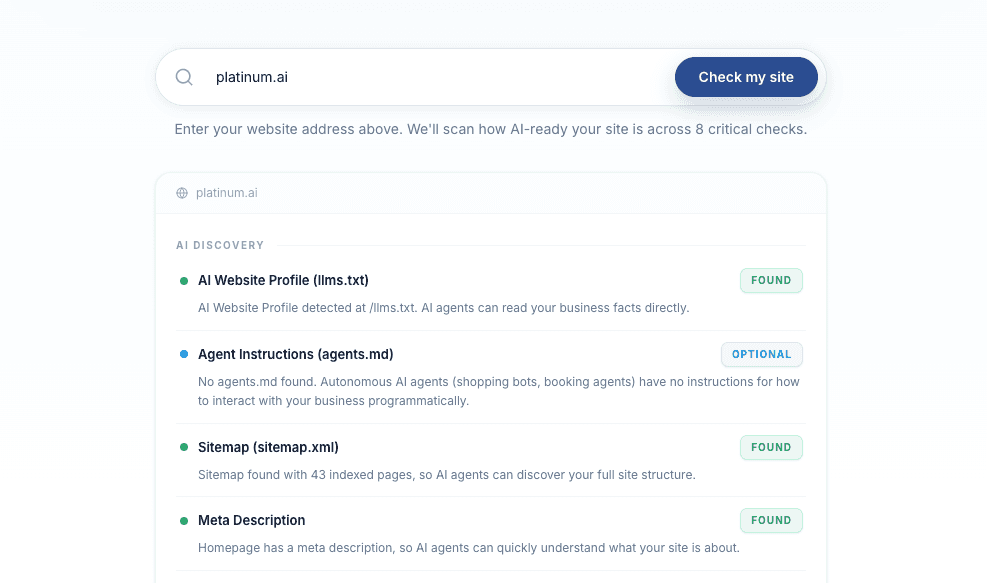
The AI Readiness Scanner shows you exactly what these agents see. Enter your domain. Get a score in seconds. See what's working, what's broken, and what to fix first.
What the Scanner Checks
The scanner evaluates your site across 8 checks, organized into four categories. Each check gets a clear pass, warning, or fail, with a plain-English explanation of what it means for your AI visibility.
AI Discovery
1. AI Website Profile (llms.txt). The single most important signal. llms.txt is a plain markdown file at your domain root that gives AI agents a structured summary of your business. Over 844,000 websites have adopted it, including Stripe, Cloudflare, and Vercel. If you have one, the scanner confirms it's at the correct URL and runs a quality analysis: profile completeness, overview, services, key facts, key pages, structured tables, and canonical excerpts. If you don't have one, you get a clear "NONE" and a description of what agents are forced to do instead.
2. Agent Instructions (agents.md). An optional but emerging standard. agents.md gives autonomous AI agents (shopping bots, booking agents, research assistants) instructions for how to interact with your business programmatically. Most sites don't have this yet. The scanner flags it as optional and explains when it matters.
3. Sitemap (sitemap.xml). AI agents use sitemaps to discover your full site structure. Without one, agents may miss important pages entirely. The scanner checks for sitemap.xml and reports how many pages are indexed.
4. Meta Description. A fast, reliable signal that tells AI agents what your business does before they even parse your full page. The scanner checks whether your homepage has one, and flags it if missing.
AI Permissions
5. AI Bot Rules (robots.txt). AI agents respect robots.txt. If your file blocks AI crawlers, intentionally or accidentally, you're invisible. The scanner checks your robots.txt and reports whether AI crawlers have open access, restricted access, or no guidance at all.
Data Structure
6. Structured Data (JSON-LD). Schema.org markup gives AI agents typed, explicit facts instead of forcing them to infer meaning from prose. Structured data reduces AI hallucination rates by 40 to 60%. The scanner detects whether your site has JSON-LD schema and explains what it means for AI understanding.
7. Open Graph Tags. When your links are shared or referenced, Open Graph metadata provides preview context. The scanner checks for these tags. They help AI agents understand your business when they encounter your links across the web.
Agent Load
8. Homepage Weight. How many tokens does your homepage cost an agent to parse? The scanner measures your page weight in both characters and tokens, then rates it: Light, Medium, or Heavy. A lightweight page is fast and cheap for agents to read. A heavy one (packed with JavaScript, verbose copy, or bloated markup) costs more and gets skipped more often.
Estimated Agent Research Cost. Based on your site structure, the scanner estimates what it costs an AI agent to research your business: how many pages it would crawl, how many tokens it would consume, and the approximate dollar cost per research session. For sites with an llms.txt profile, this cost drops dramatically. Agents read one file instead of crawling multiple pages.
What You Get
After scanning your domain, you get an AI Readiness Score (0 to 100) with a letter grade from F to A. Pass, warning, and fail counts at a glance. A check-by-check breakdown with plain-English explanations. For sites with llms.txt, a quality analysis showing profile completeness and section-by-section coverage. And if your score is low, a direct CTA to fix it.
The report is designed to be actionable. You won't get a 40-page PDF full of jargon. You'll get a clear picture of what's broken and what to do about it.
What a Real Scan Looks Like
Here's what we see when we scan actual domains. A site with an AI Website Profile, like platinum.ai itself, scores 98 out of 100, Grade A. llms.txt found, sitemap with 39 indexed pages, meta description present, robots.txt passing, JSON-LD schema detected, Open Graph tags in place, homepage weight light at roughly 24,733 tokens, and agent research cost bypassed because the profile replaces multi-page crawling.
A site without one scores 20 out of 100, Grade F. No llms.txt, no sitemap, no meta description, no robots.txt, no structured data, no Open Graph tags. AI agents must parse heavy visual code just to extract basic facts. Most of the time, they don't bother.
The difference is stark. Same scanner. Same 8 checks. One site is ready for the agentic web. The other is invisible.
Why This Matters Now
AI-driven search isn't a future trend. It's happening right now. ChatGPT has over 400 million weekly active users. Perplexity processes over 100 million queries per month. Claude, Gemini, and a growing ecosystem of AI-powered search tools are changing how people find and evaluate businesses. When someone asks an AI "what's the best [your industry] for [your customer]," your business should be in the answer.
But being in the answer requires being readable. And most businesses aren't. The gap between AI-invisible and AI-readable is usually small. A structured profile. Cleaner markup. Consistent facts. The businesses that close this gap now will have a multi-year head start.
Try the AI Readiness Scanner now at platinum.ai. No signup required. No credit card. Just your domain and 30 seconds.