

Key Takeaways
- AI adoption requires a strategic plan, not just dabbling with tools, to achieve sustainable growth and competitive advantage.
- A successful AI implementation is a transformation that necessitates a clear roadmap.
- Businesses that excel with AI are those that approach it with a well-defined strategy.
Building Your 12-Month AI Roadmap: From Quick Wins to Competitive Moats
Artificial intelligence is not a magic wand you can wave at your business to instantly solve all its problems. It's a transformative technology, and like any transformation, it requires a plan. Simply dabbling with a few free tools without a clear strategy might produce some interesting novelties, but it won't lead to sustainable growth or a meaningful competitive advantage. Businesses that succeed with AI are the ones that approach it with a clear, phased roadmap.
Many businesses make one of two critical mistakes. Some get stuck in a state of permanent "dabbling," never moving beyond simple, one-off tasks. Others try to do too much, too soon, attempting to build a complex, custom AI solution before they've even mastered the basics. This often leads to burnout, budget overruns, and abandoned projects. As one popular saying in the industry goes, "Most businesses fail with AI not because of the technology, but because they try to build a moat before they've learned to swim."
This guide provides a structured, 12-month AI roadmap designed specifically for small and medium-sized businesses. It breaks the journey down into three manageable, four-month phases, guiding you from low-risk, high-ROI "quick wins" to the strategic implementation of AI that can become a true, defensible competitive advantage, or "moat."
Phase 1: The First Four Months - The Quick Win Factory
Goal: To build momentum, generate immediate ROI in the form of saved time, and foster a culture of AI adoption by focusing on low-cost, low-risk internal productivity tools.
In this initial phase, the focus is entirely internal. You are not changing anything about your customer-facing products or services. You are simply using readily available AI tools to make you and your team more efficient. This is the foundation upon which everything else is built.
Key Actions for Months 1-4:
-
Prioritize AI Literacy: Your first step is education. Have your team read articles (like the ones on this blog!), watch tutorials, and dedicate a small amount of time each week to simply playing with free tools like ChatGPT, Claude, and Perplexity. The goal is to demystify the technology and build comfort and curiosity.
-
Identify and Automate 3-5 Repetitive Tasks: Conduct a time audit. Where are the biggest administrative drains? Common targets include:
- Transcribing and summarizing meetings.
- Drafting routine emails.
- Brainstorming and outlining content.
- Proofreading and editing.
- Writing first drafts of SOPs. Commit to using AI for these tasks consistently.
-
Establish a 'Prompt Library': Don't reinvent the wheel every time. Create a shared document where you and your team can save the most effective prompts for your common tasks. This becomes a valuable internal asset that accelerates adoption.
-
Master One Generative AI Tool: Instead of trying to use a dozen different apps, choose one primary generative AI tool and learn its features deeply. Master its use before expanding to others.
Measuring Success in Phase 1:
- Primary Metric: Hours saved per employee per week.
- Secondary Metric: Number of documented, automated workflows in your prompt library.
By the end of this phase, your team should feel comfortable with AI as an assistant. You should have tangible proof of its value in the form of reclaimed time, which creates the buy-in and enthusiasm needed for the next phase.
Phase 2: The Next Four Months - Scaling for Growth
Goal: To move from internal efficiency to external impact. In this phase, you will strategically deploy AI in customer-facing roles to improve marketing, sales, and support.
Now that your team is comfortable with AI, you can start using it to directly impact your bottom line. The focus shifts from saving time to generating revenue and improving the customer experience.
Key Actions for Months 5-8:
-
Deploy an AI Chatbot: Implement an intelligent chatbot on your website. Start with a simple FAQ-answering bot (as outlined in Phase 1 learnings) and then enhance it to qualify leads and book meetings, directly feeding your sales pipeline.
-
Supercharge Your Content Marketing: Use the AI-driven content creation workflows you've mastered to increase your content velocity. Implement an AI-powered process for SEO research and content brief creation to ensure your content is designed to rank and attract organic traffic.
-
Personalize Your Marketing: Begin using the AI features in your email marketing or CRM platform to segment your audience and deliver more personalized campaigns. Start with a simple segmentation, like creating a specific campaign for new customers versus loyal, repeat purchasers.
-
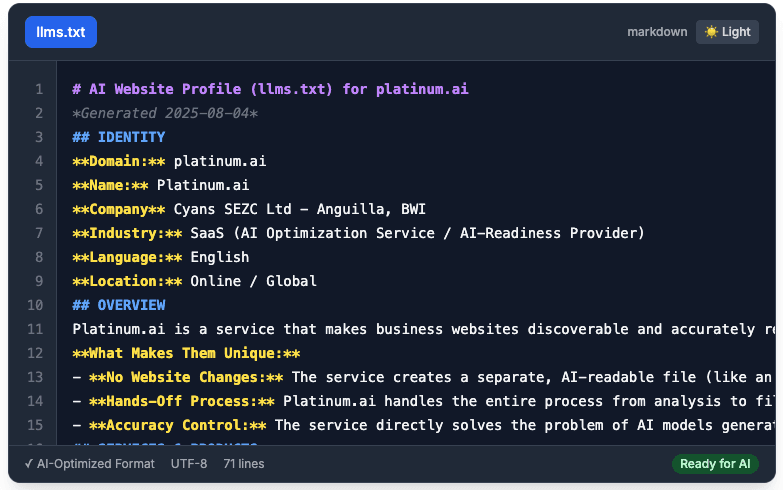
Optimize Your AI-Discoverability: This is a critical technical step. Invest in ensuring your website has complete and accurate structured data (Schema.org). This makes your business's information legible to AI assistants and is the foundation for being found in conversational search. This is the perfect time to engage with a service like Platinum.ai.
Measuring Success in Phase 2:
- Primary Metrics: Increase in qualified leads from the website; growth in organic traffic; improvement in email campaign engagement rates.
- Secondary Metric: A successful audit of your website's structured data.
Phase 3: The Final Four Months - Building the Competitive Moat
Goal: To leverage AI in a way that is unique to your business, creating a lasting competitive advantage that is difficult for others to replicate.
In this advanced phase, you move beyond using generic tools for common problems and start thinking about how AI can enhance your core value proposition. The focus is on strategic differentiation.
Key Actions for Months 9-12:
-
Explore Industry-Specific AI Solutions: Look beyond the general-purpose tools. Are there AI platforms designed specifically for your industry (e.g., AI for legal research, AI for real estate market analysis, AI for medical scribing)? Adopting a specialized, vertical-specific tool can provide a significant edge.
-
Analyze Your Proprietary Data: Use AI to analyze your own unique business data to uncover insights no one else has. Analyze thousands of your customer reviews to truly understand their needs. Analyze your sales data to identify your most profitable customer profiles. The insights from your data are a key competitive asset.
-
Create 'Agentic Workflows': Go beyond single-tool automation. Use platforms like Zapier or Make to chain multiple AI tools together to automate a complex, end-to-end process. For example, a new lead in your CRM could automatically trigger an AI to research the lead's company, draft a personalized outreach email, and schedule a follow-up task.
-
Evaluate the 'Build vs. Buy' Decision (Cautiously): Now, and only now, after a year of experience, should you even consider the possibility of a custom AI solution. If you have identified a truly unique problem and possess a massive proprietary dataset, you can begin to explore what a custom build might entail. For most, the conclusion will still be to stick with buying and integrating, but you can now make that decision from an informed, experienced perspective.
Measuring Success in Phase 3:
- Primary Metrics: Launch of a new AI-enhanced service or product; measurable improvement in a core business KPI based on a unique AI-driven insight.
- Secondary Metric: Successful implementation of at least one complex, multi-step automated workflow.
This 12-month roadmap provides a clear, logical progression. It ensures you build a solid foundation of internal competency before you attempt more complex, external applications. By following this phased approach, you can integrate AI into the fabric of your business thoughtfully and strategically, transforming it from a curious novelty into your most powerful engine for growth.