
Key Takeaways
- AI is fundamentally changing SEO in 2025, moving beyond traditional search engines.
- AI agents, voice assistants, and generative interfaces are becoming the primary ways users interact with information.
- SEO strategies in 2025 must adapt to these new AI-driven search paradigms.
The Rise of AI Agents and Generative Search
We've moved from typing into search boxes to conversing with AI. Whether it's ChatGPT, Perplexity, Gemini, or industry-specific assistants, users now expect answers—not links. These AI systems don't care about your site's page rank. They care about extracting accurate, relevant, and structured information to synthesize an answer.
As a result, SEO is no longer about gaming Google's algorithm. It's about making your content legible and valuable to AI models that scrape, summarize, and relay your message to users directly—often without ever showing your site.
Search is Fragmenting—And That's a Problem
In the past, businesses had a single gatekeeper: Google. But now, there's a new reality—fragmented search. Some users still Google. Others ask ChatGPT or use vertical tools like Klarna AI for shopping, Harvey AI for legal, or MosaicML agents trained on custom corpora.
Your content needs to be accessible to all of them.
This means:
- Structured data is no longer optional.
- Ambiguity is punished—AI doesn't guess.
- You need to think in terms of retrievability, not just visibility.
From Keywords to Knowledge Embedding
AI agents don't "search" the way humans do. They embed meaning into vector spaces and retrieve information based on semantic relevance. That's a game-changer. Old tricks like keyword stuffing or backlink pyramids don't move the needle anymore. Instead, clarity, structure, and direct answers win.
Here's what matters now:
- Topical authority: AI agents prefer citing sources with consistent, domain-specific depth.
- Structured facts: Lists, FAQs, and clearly segmented pages get picked up more easily.
- Context clarity: Pages that introduce a topic, explain it, and wrap it up cohesively are easier to embed and retrieve.
If your site's structure is chaotic, or your content vague, you're invisible to AI—even if you're technically "indexed."
The Death of Clicks
Zero-click search was already eating into traffic. Now, AI summarization has taken it to the next level. Entire product comparisons, definitions, and recommendations are consumed in the chat window or voice reply—without a single visit to your website.
This is painful for traffic metrics. But it's not the end. Instead of chasing clicks, smart businesses are now optimizing for:
- Citation in AI responses (think of it like the new backlink).
- Brand mention and recognition in synthesized results.
- Conversion-ready content when users do choose to visit your site.
A New Layer: AI-Optimized Site Files
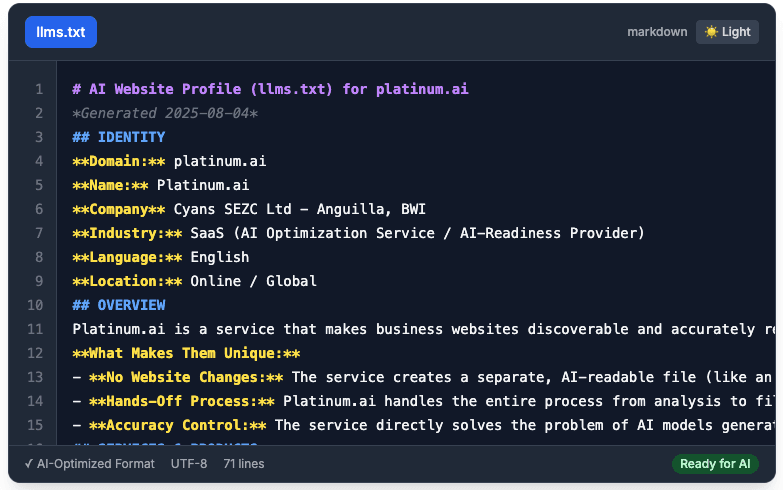
Forward-looking companies in 2025 are creating structured site maps tailored for AI agents. Think of them as "LLMs.txt" files—concise, well-structured content summaries that make it easy for AI to know what you do, what you offer, and why it matters.
These new files help:
- Reduce hallucination risks by offering ground-truth data
- Improve agent reliability when answering about your company
- Ensure product specs, pricing, and value props are always accurate
As AI agents become the default interface to the web, these structures will be essential. They're the new robots.txt for a new generation.
What You Should Do Now
The SEO game hasn't disappeared—it's just evolved. Here's how to adapt:
- Audit your site for AI readability, not just human UX. Can an AI model extract key facts from your page with minimal confusion?
- Start building AI-structured summaries, FAQs, and context-rich overviews. Don't leave meaning to chance.
- Track mentions and citations in AI agents, not just Google Analytics. Brand visibility now extends into synthesized responses.
- Diversify your content visibility across platforms and interfaces. Ensure your product or service shows up on voice interfaces, chat UIs, and vertical agents—not just search engines.
Final Thoughts
2025 marks the year when SEO left the search bar. As AI agents intermediate more user queries, the future belongs to businesses that speak fluently to these systems. It's not about ranking—it's about being retrievable, reliable, and relevant in the age of AI.
If your SEO team still thinks in SERPs, it's time for a reset.