

Key Takeaways
- Competitors are increasingly adopting AI to gain an advantage in speed, intelligence, and efficiency.
- Staying ahead requires actively identifying and understanding how competitors are leveraging AI.
- Ignoring the AI arms race can leave businesses at a significant disadvantage.
Your Competitors Are Using AI. Here’s How to Find Out.
In the competitive landscape of small business, staying informed about your rivals' strategies is paramount. You watch their pricing, monitor their marketing campaigns, and keep an eye on their new product launches. But there's a new, invisible arms race taking place: the race to adopt artificial intelligence. Your competitors might be quietly using AI to become faster, smarter, and more efficient, and if you're not paying attention, you could be left wondering why you're suddenly struggling to keep up.
The challenge is that, unlike a new storefront or a big advertising campaign, a company's use of AI is often subtle. It happens behind the scenes, in their internal workflows and content creation processes. However, AI adoption leaves a trail of digital breadcrumbs. If you know where to look, you can get a surprisingly accurate picture of how deeply your competitors are invested in AI.
This guide provides a practical checklist for performing competitive intelligence in the age of AI. It will teach you how to be a digital detective, spotting the tell-tale signs of AI adoption so you can benchmark your own progress and ensure you don't fall behind the curve.
1. Analyze Their Content Velocity and Quality
The Clue: A sudden, dramatic increase in the volume of their content marketing (blog posts, social media updates, etc.) that doesn't seem to correlate with a change in their company size.
The Investigation:
- Look at their Blog: Check the publication dates on their blog posts. Was a business that used to post once a month suddenly posting twice a week, every week, for the past six months? A single person or a small team can use AI to research, outline, and draft content at a rate that was previously only possible for a much larger marketing department.
- Examine the Content Itself: Look for the subtle hallmarks of unedited AI-generated text. Is the writing grammatically perfect but a bit soulless and generic? Does it use repetitive sentence structures? Does it have a tendency to list things without providing deep, unique insights? While sophisticated users edit their AI content, less experienced ones often publish the first draft, and it shows.
- Check Social Media Feeds: Is their social media presence suddenly prolific and perfectly consistent? AI tools excel at taking one piece of content (like a blog post) and repurposing it into a dozen different social media updates. This level of consistent, high-volume output can be a strong indicator of AI assistance.
2. Interact With Their Website's 'Employees'
The Clue: The presence and sophistication of automated tools on their website, particularly their chatbot.
The Investigation:
- Engage the Chatbot: Don't just look to see if they have a chatbot; interact with it. Test its intelligence. Ask it simple questions first ("What are your hours?"). Then, ask it more complex, nuanced questions.
- Is it a simple, script-based bot that breaks easily? (Low AI adoption).
- Can it understand the intent behind your question even if you phrase it awkwardly? (Medium AI adoption).
- Does it remember the context of your conversation? Does it personalize its responses? Can it hand you off seamlessly to a human agent? (High AI adoption).
- Test Their On-Site Search: A website with an AI-powered search function will understand natural language queries, not just keywords. Instead of searching for "pricing," try searching for "how much does your pro plan cost per year?" A smart search will give you a direct answer.
3. Peek Under the Hood of Their Website
The Clue: The presence of specific, machine-readable code that is designed to make their business discoverable by AI.
The Investigation:
- Run a Structured Data Test: This is a powerful technical clue. As we've discussed, structured data (Schema.org) is the language that AIs use to understand the factual information about a business. You can use Google's Rich Results Test to analyze your competitor's website.
- Enter their homepage URL. If the test comes back with a long list of detected items like
LocalBusiness,Service,FAQPage, andProduct, it's a clear sign that they are technically sophisticated and are actively optimizing their site for AI and advanced search. This is a strong indicator of a forward-thinking AIO (AI Optimization) strategy. - If it only detects a basic
Websiteitem or nothing at all, they are likely behind the curve on AI-readiness.
- Enter their homepage URL. If the test comes back with a long list of detected items like
- Check for an
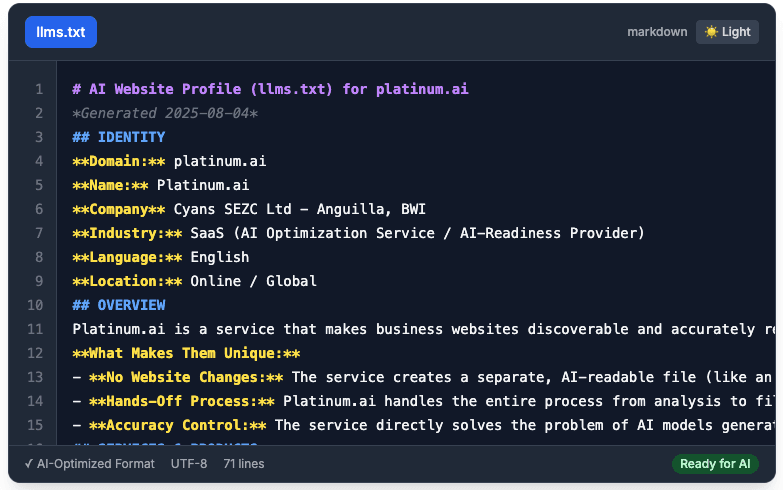
LLMs.txtFile: This is a more advanced technique, but it's a dead giveaway. TheLLMs.txtfile is a new, emerging standard that allows a website to give specific instructions to AI models. Try navigating tohttps://[competitorwebsite.com]/llms.txt. If a file loads (even a simple one), it means they have an extremely high level of AI awareness and are actively thinking about how their data is being used by AI.
4. Monitor Their Hiring and Public Statements
The Clue: The types of jobs they are hiring for and the language they use in their public-facing materials.
The Investigation:
- Check Their Job Postings: Look at their 'Careers' page or their listings on LinkedIn. Are they hiring for roles that didn't exist a few years ago? A posting for a "Prompt Engineer," an "AI Content Strategist," or a "Marketing Automation Specialist" is a clear signal that they are building internal AI expertise.
- Read Their 'About Us' Page and Press Releases: Are they starting to use AI-centric language? Do they talk about "data-driven insights," "intelligent automation," or how they are "leveraging AI to deliver better customer outcomes"? Businesses that are proud of their tech adoption will often talk about it publicly.
What to Do With This Information
The goal of this intelligence gathering is not to panic or to blindly copy your competitors. The goal is to benchmark your own efforts.
If your analysis reveals that your top competitors are heavily invested in AI—they have a high content velocity, a smart chatbot, and robust structured data—and you haven't even started your AI journey, it should create a healthy sense of urgency. It's a sign that your industry is moving forward, and you risk being left behind.
Conversely, if you find that your competitors are showing no signs of AI adoption, it represents a massive opportunity. By becoming an Early Adopter, you can build a significant competitive advantage in efficiency, marketing, and customer experience before they even realize the race has begun.
In the past, competitive advantages were built on physical assets or capital. Today, they are increasingly built on data and intelligence. Understanding your competitors' AI strategy is no longer just a technical curiosity; it's a critical component of your own business strategy.